July 10 and 12 set list

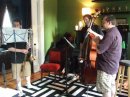
Rob, Riley, and Ryan practicing for this weekend's shows.

The Viper and His Famous Orchestra played two shows this past weekend in Chicago, our first shows with the full band since 2002, and our first shows to feature a significant amount of new material since 2000, when the Viper up and left for Ankara, Turkey.

Thanks to all who came, or told others to come, expressed an interest in coming, expressed regrets about their inability to come, expressed regrets about their ability to come, expressed no interest in coming, told others not to come, or walk-ran quickly away the moment we started playing. We had a great time playing and catching up with a lot of our favorite people this weekend. That includes each other: Ryan Jerving, Edward Burch, Victor Cortez, Rob Henn, Kenneth Rainey, Riley Broach, and Bill Whitmer (who leaves for Scotland on Tuesday).

Both shows were a welcome challenge and a lot of fun, not least for the wide-ranging and moving sets that Edward Burch played at each of them with various stellar collaborators (LeRoy Bach, Steve Frisbie, Kenneth Rainey, John Peacock, and Riley Broach).

We hope to see you August 7 and/or 9 in Champaign-Urbana at Mike ‘n’ Molly’s. Meanwhile, here’s what you would have heard this past weekend, and the keys in which you would have heard it:

Friday, July 10, Hotel SnS (house show)

  • Ich Bin Berlin – C
  • Hey! Rounders / Superbowl Shuffle – C
  • Das Kapital – A
  • Good Morning Irene – G
  • Whispering – C
  • Think about Your Troubles – Db
  • Drunk Bus – Am
  • They’re Knocking Down Our Home – E
  • Neapolitan – A/Bb
  • Ballad of the Henry 55 – F
  • My Seafaring Lassie – C
  • Pretty Is as Pretty Does – C
  • Benny Lava – Cm
  • Wanna Be Startin’ Something – B
  • Winnebago Bay – G
  • Last Call Waltz – F

July 12, Great Performers of Illinois 2009 festival, Millennium Park

SET #1

  • The Viper’s Blue Yodel no. 6.02 x 10 to the 23rd -G
  • I Left My Liver in Libertyville – Bb
  • There Is a Tavern in the Town – Eb
  • Das Kapital – A
  • Are You Now, or Have You Ever Been…Blue? – F
  • Fillmore & Buchanan March – C/G
  • Winnebago Bay – G
  • Good Morning Irene – G
  • Whispering – C
  • Think about Your Troubles – Db
  • Pitfall – F
  • Let’s Go Fishing – F
  • Heyse Latke Kalte Latke – D
  • Drunk Bus – Am

SET #2

  • First Round Polka – F/C
  • Randolph St. – D
  • Hey! Rounders / Superbowl Shuffle – C
  • Benny Lava – Cm
  • Next Time I Drink – E
  • Surplus Labor – E
  • Neapolitan – A/Bb
  • Ballad of the Henry 55 – F
  • My Seafaring Lassie – C
  • Ich Bin Berlin – C
  • Wanna Be Startin’ Something – B

When the Viper up and leaves

I’m finally getting around to chopping and screwing some material I recorded on December 12, 2008 in the cabana behind Mike Paul’s house in preparation for a show The Viper with playing with the Paint Branch Ramblers at the Home Grown Coffee House in Accokeek, Maryland later that evening. I also recorded the show. But in a misguided bit of engineering, I pointed the microphone directly at the ceiling and, so, captured a lot of crowd murmuring and vocal reverb and not much else.

In any case, here’s a rehearsal track of my opening song from that set, “The Viper’s Blue Yodel no. 6.02 x 10 to the 23rd” or “A Mole of the Blues”:

(click here to download the mp3)

This is recorded live straight into Audacity using a single microphone for both the vocals and the baritone ukulele.

I’ve been doing versions of this since as early as 1997 or 1998. But in its finished form, I performed first at this same Home Grown Coffee House venue in February of 2007. At that point, my talk of leaving Maryland for Wisconsin and the danger of adjustable rate mortgages was purely speculative. But before all things must pass, all things must also come to pass. And that was the case by December 2008 when this song served as an actual goodbye to living south of the Mason-Dixon line.

Lean with it, rock with it

Here’s a scratch recording that I made for Edward Burch to practice along with, to get the Run-DMC-style vocal interpolations I want to do with him on the first verse of “Drunk Bus”

http://theviper.wikispaces.com/file/view/drunk-bus-first.verse.mp3/80335421
(click here to download the mp3)

“Drunk Bus” is a song by Macomb, Illinois-based rapper Tre-P, and it falls into my favorite category of songs: namely, songs about the details of local public transportation, particularly buses.* In this case, that bus is the eponymous free shuttle that would take Western Illinois Universities from the clubs back to their dorm late at night. Here’s Tre-P, in full flash animation:

Watch for the secret interpolated shot at 1:46.

* Cf. The Viper and His Famous Orchestra, “Ich Bin Berlin” (on the Champaign, Illinois MTD bus route up North Prospect to the Meijer grocery store, “where parking’s the only sound”) and “Ukulele Rhythm” (about riding on the Blue bus–the 4W bus–that went from my place on Hill St. in Champaign to the International Cafe on Wright St. in Urbana where the orchestra and I would sometimes play of a Friday afternoon in the late 1990s).

It’s the new shmoo

You’ll notice a slightly different set up to this space, one that aims at pretending this is simply a blog, but a proper web site for a working band, with a simple above-the-fold homepage and everything.

I make no apologies for this nod to crass commercial realities and only hope you’ll realize the Viper is the same self-centered, logorrheic amateur he’s always been.

Using MuseScore to create lead sheets

As I noted in an earlier post, I recently purchased Finale NotePad, the cheap-o version of this music notation software. I needed it to create some basic lead sheets for some new material that The Viper and His Famous Orchestra will be debuting at our summer shows for 2009. Lead sheets are a practice tool for bands working in a vernacular tradition — they typically include just a simplified version of the “head” melody of a song written out on a treble-clef staff, with chord symbols written above the staff (like what you’d find in a fakebook).

As a notation project, a lead sheet is a pretty simple creature and doesn’t require all the bells and whistles that someone doing, say, a full orchestral score would need from software. And I found NotePad pretty easy to figure out to quickly get a line of music down on paper. But because lead sheets are created for musicians who need it mostly as spot-check reference tool for practicing, and for musicians who may or may not be skilled readers of music, they do create there own demands on someone notating the music — mostly, demands for simplicity.

Some of these demands I found hard to meet with Finale NotePad. Most notably, I found I couldn’t get the line to break where I wanted it so that there’d be a nice, round, easy-to-read four measures per line  on the page. This doesn’t sound like a big deal – but it makes a lead sheet infinitely more useful as a practice tool if it can be set up this way.

On my earlier post, I noted this issue with NotePad and mentioned that I was going to be trying out an alternative, free and open source program called MuseScore. Well, within less than a day, I’d been contacted by two separate boosters of MuseScore with helpful advice and more. A David Bolton commented on my post, saying “MuseScore can add grace notes and double bar lines plus many more things that NotePad can’t do.” And then some superhero known only as “Lasconic” emailed me out of the blue, having voluntarily taken on the project of himself or herself inputting my lead sheet for “Heyse Latke” into MuseScore. As he/she writes:

I created a musicXML file from your pdf with an OMR software and open the musicXML with musescore. Then I modify it. The most recent prerelease of musescore has a plugin to break every 4 measures automatically. You can break where you want too of course. You can label the part with rehearsal marks, and use double barlines. I didn’t put any appogiatura, but it’s also possible. Not sure you’re playing a mandolin, I thought it was a ukulele. I didn’t change it neither but it’s possible as well. The result looks cleaner and beautiful, at least for my taste. Hope you like it! Tell me what you think and try musescore! It will be great to have your feedback on the forum: http://musescore.org/en/forum.

And he/she is right: it is cleaner and beautiful. Take a look at:

http://dl.getdropbox.com/u/497455/heyse-latke.pdf

Or the musescore file at:

http://dl.getdropbox.com/u/497455/heyse-latke.mscz

I haven’t yet properly thanked Lasconic or written to the forum. But I have begun using MuseScore and am finding it to be absolutely perfect for my purposes. There are some issues with needing to download a supplementary midi pack to be able to play back some of the fuller, multi-staff scores I’m now also creating with it. But for creating basic lead sheets, it’s an easy-to-learn, simple-to-use program for creating very usable, professional looking stuff. I’m very impressed and happy with it.

the kind of music your great-great-great-grandparents warned your great-great-grandparents about