If you’re looking for a holiday-specific ringtone — or just enough audio gelt to cover the gifts you’ll need for the first three nights of Hanukkah — then The Viper has got your back. I’m no Orrin Hatch (see below for the video), but I try.
Below are some 15-20 second-long clips from The Viper and His Famous Orchestra playing “Heyse Latke Kalte Latke (Hot Latke Cold Latke)” during our Champaign-Urbana show of August 9, 2009. They feature Rob Henn on trombone, Edward Burch and Victor Cortez on dueling suitcases, Kenneth P.W. Rainey on the electric 5-string mandolin, Riley Broach on the double bass, and The Viper on the cümbüş banjo mandolin. Three different bits have been selected for your pleasure and served up hot. Sour cream and applesauce are not included.
Instrumental verse Featuring the mandolin and cümbüş. This is the ringtone the Viper is currently using. mp3 | midi | wav
Slow trombone chorus It’s the plumber — he’s come to shvitz the sink. mp3 | midi | wav
These are being provided in different formats (mp3, midi, and wav) since different phones have different needs. (Mine requires me to e-mail a midi file to my phone as a “picture” attachment and then save it as a ringtone.)
Here’s an mp3 of the whole recording, unedited and unequalized. (I’ll get around to archiving the whole show one of these days.)
The Viper and His Famous Orchestra, “Heyse Latke Kalte Latke” Live at Mike N’ Molly’s, Champaign, Illinois, August 9, 2009 mp3
And for more than you ever wanted to know about “Heyse Latke Kalte Latke,” here’s the 1, 2, 3, 4, 5, 6, 7, and 8 part series I wrote last year at about this time when I was in the middle of moving to Milwaukee and leaving behind Maryland and the Paint Branch Ramblers, the group with whom the song had its first livelihood.
As you thank Abraham Lincoln and Sarah Joseph Hale for bringing you the national holiday you are about to enjoy, save an empty space on your plate for Millard Fillmore and James Buchanan, two U.S. Presidents who (along with Zachary Taylor and Franklin Pierce) ignored Hale’s entreaties and passed on the chance to institutionalize Thanksgiving.
And as you remember Fillmore and Buchanan, take a gander — if you haven’t already taken the goose — at some recently digitized pieces by 8 great contemporary American artists that we are featuring in the new archival section of the viper.org site.
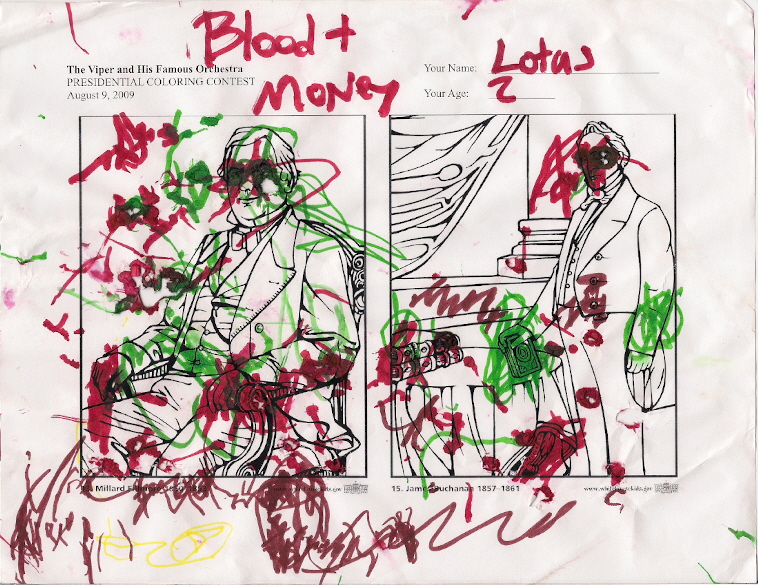
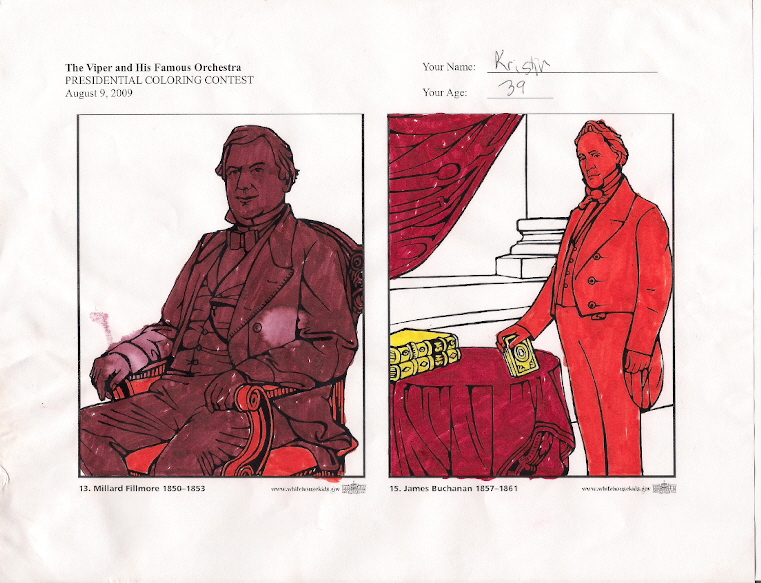
For an August 9, 2009 afternoon show that was to be billed as kid-friendly — and for a Wisconsin native like the Viper, kid-friendly means held in the outdoor beer garden of Mike ‘N Molly’s in Champaign, Illinois — The Viper and His Famous Orchestra sponsored a coloring contest. To accompany our performance of the “Fillmore & Buchanan March” we asked members of our audience to do what they would with two public domain portraits (courtesy of whitehouse.gov) of the eponymous Millard Fillmore and James Buchanan: two of our least remembered, least loved, and best forgotten U.S. Presidents.
Contestants who submitted entries ranged in age from 2 to 46. The entries were judged by Irene Jerving, Sophie Rainey, and Anna E. Staley. Below we present a sampling of the best of the best. Click on the thumbnail for a full-size version of the image.
by Lotas, age 2
by Sage, age 4
by Caroline, age 4
by Charlotte, age 5
by Maeve, age 5
by Ciara, age 15
by Kristin, age 39
by Tom, age 46
If you missed out on the contest, it’s not too late: you can still download and print out the PDF of the coloring sheet, complete it (as you complete me) and mail it to Ryan Jerving / 2171 N. Hi-Mount Blvd. / Milwaukee, WI 53208. When I get a chance, I’ll upload any entries I receive to this space and to our Facebook fan page.
For information on the “Fillmore and Buchanan March” itself (and some recordings and ring tones of various versions), see this site’s blog entries for November 14, 2008 and February 28, 2008.
At the tail end of this past October, Champaign-Urbana’s online culture magazine, Smile Politely, put together a list of their top-20 albums by local bands from the first decade of this millennium. The Viper and His Famous Orchestra made a respectable showing with Everything for Everyone at #19. I’d always wanted to be 19th best at something! Joseph Martin’s account, describing us “coming on like a chipper Cultural Studies salon,” is a very nicely turned framing of this recording in its socio-historico-portico context.
Note also that the Orchestra’s suitcase-player-errant, Edward Burch, also shows up at #15 with The Palace at 4 a.m. (Part 1) as the latter half of Jay Bennett & Edward Burch. And Orchestra percussionist, Victor Cortez, gets an honorable mention with Rectangle’s Uno Nunca Sabe.
PART TWO OF TWO see yesterday’s post for the background on The Viper and His Famous Orchestra’s recording sessions with Jay Bennett for our Everything for Everyone CD. Scroll down to the end of this post to see Edward Burch’s unedited comments.
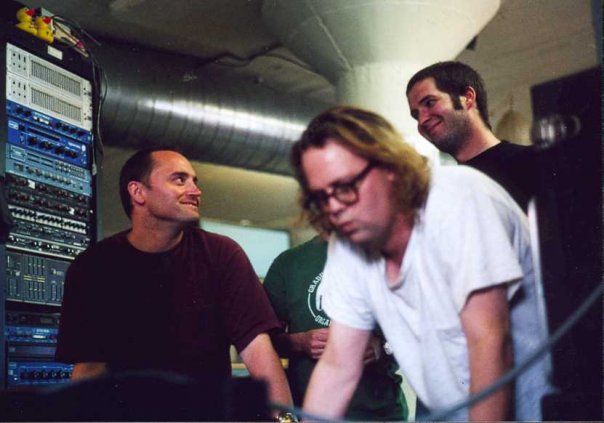
Jay Bennett mixes Everything for Everyone while The Viper and His Famous Orchestra look on. Photo taken by Edward Burch.
Before we had a chance to do anything with the tapes from the studio recordings that Jay engineered and produced in 2000, I took a teaching job in Ankara, Turkey. It wasn’t until I was visiting the Midwest on a research trip the following summer that we had a chance to get together again with Jay to mix and pre-master the tracks, this time at the Chicago loft where Jay’s band, Wilco, rehearsed and kept their stuff. You can get a pretty good look at the layout of the place in Sam Jones 2002 documentary about that band, I Am Trying to Break Your Heart. It should be noted that the summer of 2001 was a strange time for Wilco.
MIXING
THE VIPER: So how about the mixing sessions we did with Jay in Chicago. What do you remember about the space?
ROB HENN: At least in my memory, the Wilco loft was this huge place, ragged blonde wooden floors that covered the whole of a rectangular room, and an impossible number of guitars stacked on a giant two-tiered rack that stretched far into the back of the loft.
RILEY BROACH: I remember thinking: Jay has an insane amount of guitars! There were shelves upon shelves upon shelves of guitars. I asked Jay, have you played every single one of these guitars? He responded something to the tune of, “yeah, some of them for only one song.” To which I responded, “why?” And he responded, matter-of-factly, “no other guitar makes that sound.”
RH: I remember seeing that every member of Wilco had a desk. Jeff Tweedy’s desk was notable in particular for the large number of books piled on the wall next to it; they were surprisingly literary and obscure, and for some reason I remember that a number of items were from Grove Press. I particularly remember you looking at this stack and remarking with mock-anxiety, “Oh no! Jeff Tweedy might be even more hip than I am!” You said nothing of the sort when a little while later Tweedy came into the loft briefly and we all met him.
TV: What I remember about the dynamic there was that everyone who used the place (Wilco band members included) was supposed to leave everything looking exactly as it had when they’d come in. In retrospect, that might have been an indication of a band having trouble. But at the time, this very much appealed to the anal retentive side of me, and I thought: hey! great idea.
OVERDUBS
What do you remember what we did there? I know we did at least of couple of last minute overdubs: some percussion for “Randolph St.,” some marching on a wooden equipment cart for “I Love a Girl in Moscow,” and Jay’s VERY last minute 8 bars of organ on “Pretty Is as Pretty Does.”
RB: I’m not sure who thought of the idea to record the marching Red Army, but I remember searching through that enormous loft for something with a good “marching” sound. We tried out various objects, comparing the resonance, and settled upon the wooden crate/cart. Our process seemed almost scientific. I wonder if people listening to the recording actually think a Red Army is marching. Why did we include the marching in the first place? Why are they marching?
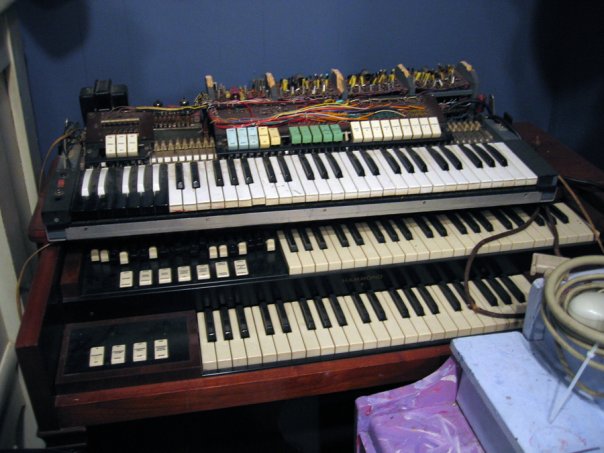
RH: For the organ on “Pretty Is,” I only remember that he did it quite quickly, as a lark almost. It was, I gather, typical Jay: a brilliant improvisation that added a lovely layer to the song, using one of the many instruments he could have chosen from. He remarked that he was drawing upon this particular organ in order to suggest an old time soap-opera sound, one that was perfect for that particular song’s (melo-) drama.
RB: It makes me think, old-timey theater. I know it was said that it sounded like a sappy soap opera theme. I suppose both interpretations capture that drama.
TV: I remember us standing around while he did his organ bit. I’m pretty sure this was literally the last thing we did on the whole record. And I’m still amazed, in retrospect, at the time and effort Jay put into this project. The organ bit is a good example. As quickly as he did it, he actually did about 4 takes where we thought 1 would have been fine, and then he mixed bits and pieces of the 4 takes into 1 on the spot. The rest of us were late for some dinner appointment (maybe even for playing a show that night?) and getting kind of antsy about getting out of there. But he wanted this backing bit for 8 bars of this track buried in the middle of this very local record to sound right!
AFTER
RH: My chief memory of Jay from mixing was an argument we got into. Oy, it was frustrating! I can’t remember the content of the “dispute” at this late date, but only that I had said some idea about the recording that Jay heard wrong, and thence thought was a stupid idea; I then spent the next five minutes or so trying to clarify what I had said, but Jay was having none of it, and continued to be contemptuous of my supposed idea. He would not brook stupidity in the recording process! We were quite prickly with each other, and Ed made a nervous joke about it. Later in our time at the loft, Jay found his trump card: he heard and then played back, at length, this snippet of my vocal mic in isolation during some backup singing. I clearly couldn’t have heard myself at all in this part of the recording — it was a melody that was too low for me, and hence I was singing softly — and the mic revealed that consequently I was horribly, embarrassingly off-pitch. Jay just kept that part playing for a while, for everyone else in the band to hear and laugh at. Me included, though a bit more nervously than everyone else. Well-played, Jay, well-played.
I had thought that Jay and I had gotten off to a truly bad start, then. But within a year or so (I think), I went to see him and Edward play at a record store in St. Louis when they were just beginning their tour in support of The Palace at 4 a.m. (Part 1). I was standing next to a CD rack in the crowded store, and accidentally jostled a few CDs in those long plastic trays. The CD trays came clattering down in the midst of some of Ed and Jay’s banter between songs. Jay stopped what he was saying and singled me out: “Nice going, ROB!” he said. “Way to ruin the show, man.” Or something to that effect.
This may sound like another attempt to embarrass me, and it was, but it was more like razzing from a big brother than anything else. He used my name with an affectionate tone, and was clearly marking me out to the crowd as a friend of the band. It was a gesture of kindness and welcoming at an embarrassing moment. Whatever he had thought of my stupid ideas previously, he now seemed to recognize me as a friendly acquaintance, someone he could kid around with in public. Thereafter, at every show I ever saw him, he would say hi as if we were the oldest of friends.
…AND, THE PHOTO
TV: We all like this picture at the top of this post a lot. Though I have to say that most of our commentary on it over the years has been about “smoldering passion shared by Ryan and Riley” or the two rubber ducks in the upper left corner. But what do you think Jay is thinking about in this picture?
RB: Perhaps, we were listening to an adjustment that Jay had just made and were thinking (in our giddiness of recording with Jay) that it sounded magnificent. You can tell by our perfectly timed smiles which was probably timed with a magical moment in the music. Whoever took that picture has impeccable timing. [That would be Rachel Leibowitz.] Jay, on the other hand, is probably thinking to himself, “ooo, that sounds terrible.” You can see his mouth in the “ooo” shape.
VICTOR CORTEZ: “Needs more toy piano…”
RH: I want to say something clever here, but honestly all I can imagine is the most mundane answer. I suspect it’s true, too: in this photo Jay is passionately, manically [maniacally?] puzzling through some kink in the mixing process, working his craft, trying to perfect even a small detail of sound for a tiny and unknown band from east central Illinois, as if it were as important to him as Summerteeth or Yankee Hotel Foxtrot. Nothing is stopping his concentration, and he’ll get the result that he wants, the result that is right and necessary for the music. He’s out of focus in this shot. But oh, it’s a picture of him, definitely.
And, as promised, here’s the unedited text of Edward Burch’s comments.
Jay agreed to do our CD because I had dirt on him, so it was a total hush deal. Actually, it was because he found what we were doing (and by “we” I mean you orchestrating the orchestrations of the Orchestra) to be so inspiring that he wanted to do whatever he could to help get the music recorded. It didn’t take much convincing. I thought his production on Everything was very Rubin-like, in the sense that it was an attempt to capture, as unmediated as possible, what the band sounded like in the room. I remember it was Jay’s idea to leave the false starts and tails on some songs, although it could have been Adam [Schmitt] and me who decided during the mastering to leave them in. (Sorry ’bout that.) Those are among the few points on the record that the mode of production draws attention to itself. So, depending on what you consider the role of the producer to be, Jay was doing most of it — got us the room at Private Studios, picked the engineer (that is to say, himself). He couldn’t have picked a better engineer, because Jay’s knowledge of the choice and placement of microphones were, I think, very key to the album sounding as good and as “natural” as it does. For me, it was certainly a treat to work with him on Everything for Everyone in a context where Jay and I were not working on our own material, just to have him guiding the session, such that he was freed from having to be concerned about the recorded output as “his” record (as he often did with Wilco or with Bennett-Burch material), but instead could focus his energies purely on someone else’s work. He often liked to comment to folks with whom he worked, “See, you really could have done this without me.” But truthfully, there’s no way we could have made the album we did without him.
In the year 2000, the Viper and His Famous Orchestra holed up for a couple of days in the smallish “B” room of a studio in Urbana, Illinois to record the tracks that would see light of day in 2002 as Everything for Everyone.
Placing the mics, twiddling the dials, and setting the vibe for the way the session would go — in a word, producing — was Jay Walter Bennett. We knew Jay through our suitcase player, Edward Burch, with whom Jay shared an apartment and with whom Jay would write and play and record a lot of great music (notably in the record they would put out as Jay Bennett & Edward Burch in 2002, The Palace at 4 a.m. (Part 1)).
Jay recorded us pretty straight — all of the performances were done live in one or two takes, in mono, a lot of the sound going through a single room mic, with only a few well placed overdubs recorded later. These included Jay’s organ backgrounds on the middle-eight of our cover of Angie Heaton’s “Pretty Is as Pretty Does.” Have a listen (the organ comes in at 1:44):
As we prepare to play at a memorial show for Jay this weekend in Champaign, Illinois, I thought it would be worthwhile to check in with the other members of the Orchestra to see what they remembered about those sessions, about mixing the tracks with Jay the following year, and about Jay in general. What follows is my e-mail interview with trombonist Rob Henn and bassist Riley Broach, edited for concision, coherence, and effect. Since Edward Burch knew Jay in a way that the rest of us really didn’t, I’m going to append his comments, unedited and untouched, to the end of the second post.
SOME CONTEXT
THE VIPER: Hey Rob, Hey Riley. I’m going to put together a post about our time with Jay Bennett and what it was like to record with him. Not overly reverent or sentimental — just kind of a matter of fact account of the kind of guy he was. So let me start out by asking what kind of contact you had with Jay before we recorded with him. For me, it was mostly through Edward [Burch]. And Jay sat in a fair amount with our honky tonk band, the Kennett Brothers — including at least once as the drummer!
RILEY BROACH: I got a call from Ed one day, asking if I could help move a piano up to his loft at 8 1/2 E. Main, which happened to be Jay’s place as well. Jay had just got an inexpensive (perhaps free) piano and needed a bunch of us to haul it 50+ stairs. I can’t remember if Jay or Ed said it but on our way up the stairs we began to falter and one of them said, “flesh heals, wood doesn’t.” I think we all got banged up a little bit hauling that thing and the wood was probably banged up too.
TV: That’s a great story, and words to live by. Though I’m going to point out that their loft was only on the second story. It probably just felt like 50+ stairs.
EDWARD BURCH: I believe the axiom was: “Skin grows back; wood doesn’t.” It was a phrase Jay picked up from the piano player in his country band, Gator Alley, with whom Jay worked briefly years ago as a piano mover. Also, Riley, the piano was on its way down the stairs, not up. We called you when we got to the landing halfway down and realized that with two people we were stuck and the piano was going nowhere. Definitely one of those thankful-for-cellphones moments.
RB: I remember half of the main room at 8 1/2 E. Main having loads of musical gear — all of which, Ed explained, belonged to Jay. Jay wasn’t around much as he was probably on tour with Wilco for many of those years. I didn’t really know much about Wilco, except that they were big. Remember, I was somewhat of a music Nazi back then. If it wasn’t Classical or avant-garde I thought it was crap. However, there were a few times that Jay was around. We (Ed, Jay, & I) probably just hung out eating carry-out, watching [TV?] or listening to some obscure singer-songwriter on record.
RECORDING
TV: Do you recall how we came to record with Jay? I remember it coming up kind of suddenly: the stars aligned and suddenly all the right people (i.e., Jay) and places (i.e. Private Studio) were open.
ROB HENN: Yes, it was a sudden thing: to this day I wish we’d had more time to prepare for it — we hadn’t played together in a few weeks at least, and I was trombonistically out of shape, and then one day it was just, “Come to this tiny garage-like studio in Urbana and record Viper songs for posterity!”
RB: I don’t really remember it being a sudden thing. I probably thought something like: it’s about time! I knew Jay was excited that we were finally recording something as well. He was a great supporter of The Viper & HFO. He didn’t ask for any compensation for his time for all those recordings – did he?
TV: Unbelievably, no. And I think he basically arranged for the studio time at a seriously discounted rate. And the CDs themselves were printed at a discount because of his (and Edward’s) affiliation with Undertow Records. I think the only thing he got out of it, financially, was that he got to keep the master tapes at the end for re-use on other projects. It was a very generous thing he did for us.
What was your impression of Jay as a producer/engineer? And what, if anything, do you remember about how he recorded you?
RH: I don’t have much to offer here. I knew nothing about recording, and Jay and Ed and you seemed content to handle it. It wasn’t particularly interesting or fun for me. I was mostly concerned to make sure my out-of-shape lip held up. I recall only that I thought Jay was professional and that this was the real deal. The comparatively loud sound of a trombone was always a problem in recording, and in a previous attempt at making a demo recording in someone’s living room we had to have me turn away from everyone else in the band in order to play into a mattress propped up against the wall — a really awkward way to play songs with an ensemble, you can imagine — but in this new one we just let a room mic take most of the trombone sound, I believe.
RB: What do you mean by how did he record me? Technically, I had a direct input from a contact pick-up, a microphone inches away from the f-hole, and a room microphone picking up my bass playing. As far as how he edited/mixed my sound, I like the deep bass sound created on that album. It was clear he wanted to capture our live sound and antics. He kept the recording rolling to pick up our banter in between takes. If you listen to the full-length album you can hear a lot of this banter in between the tracks. He knew our strength as a band and did a nice job in capturing it. We were all making each other laugh. Jay included.
VICTOR CORTEZ: [Victor along with Kenneth P.W. Rainey added some of the few overdubs on this recording, playing toy piano and lap steel guitar, respectively, on “Winnebago Bay.”] I’d never met Jay before. I was always a fan of T.L.A. [Titanic Love Affair] and Wilco, of course. I showed up at the house with my toy piano. He kinda chuckled at the sight of it when he was mic’ing it up. I remember there was a close mic and a room mic. For what I was playing, he made me do it a couple of times. So thorough.
Come back tomorrow for the second part of the story — things get interesting, tense, and lovely when we go to mix in the Wilco loft in Chicago.
the kind of music your great-great-great-grandparents warned your great-great-grandparents about




 The Viper & His Famous Orchestra