Here’s The Viper with Edward Burch and Riley Broach of The Famous Orchestra playing “Mister Sandman,” a Pat Ballard song popularized in 1954 by the Chordettes — a vocal group from The Viper’s own hometown of Sheboygan, Wisconsin (and who namecheck Liberace in the 3rd chorus, a fellow Southeastern Wisconsin performer).
We recorded this as a scratch track on my tiny little Tascam DR-05 for Riley’s mother and the rest of the sisters Halverson to use as they practice singing this song for Riley’s wedding, coming right up in July!
Edward Burch, Riley Broach, and The Viper rehearse in Champaign, Illinois, June 2013.
Something of a follow-up to my “How to build a washtub bass” series, this video shows you how to prepare a ceramic jug for playing as a musical instrument, with some advice for finding a suitable jug. If you like, you can skip the video and read instead the transcript I’ve given below.
I re-baked this jug special for Rob right before this show.
TRANSCRIPT
“How to make a jug band jug” with The Viper
Today I’m going to talk about how to prepare a jug for playing. By “prepare,” I mean finding one and then cleaning it. Cleaning it will involve getting out all the stuff that might have gone into a ceramic jug in the past, and sterilizing it to get out any remaining funk. You can put that funk back in later when you play.
Stage 1: FIND A JUG
First: finding one. This is a 2-gallon stoneware ceramic jug of the sort that you might find in an antique store, a basement, an estate sale, things like that. They’re not that hard to find. But they are a little bit hard to find cheaply, unless you’re lucky.
The good news is, it’s not the only thing you can play. Really, anything of about this size and shape will work: a glass apple cider jug (although those are harder to find these days, as well), a wine jug, old bleach bottles, laundry detergent bottles. Even things like a milk jug will work, although [with] the sides, the plastic is probably too soft to really give you good tone. You want something with about this much volume — 2 gallons is about the right amount of resonance — and you want resilient, tough sides to hold their shape.
Well, now let’s talk about cleaning.
Stage 2: CLEAN YOUR JUG
So cleaning a jug isn’t rocket science. But it is materials science. In putting these instructions together, I’ve consulted the online advice of people who deal in antique ceramics but, perhaps more importantly, home brewers and distillers. If your jug is particularly valuable and irreplaceable, you may want to go beyond what I’m saying here to make sure I’m not giving you bad advice that might lead to a cracked or otherwise wrecked jug.
I’ve got some very basic materials here. I’m going to use vinegar and bleach. And if you’ve got a glass jug, [like an] apple cider jug from the supermarket, [it’s] even easier: just warm soapy water (like you’d clean any dish). With ceramics, we have to worry a little bit more that the glaze inside may have not held up, may be porous; and any water of the kind that you might be spitting in would harm the jug and lead to funk, which will come right back at you when you play it.
I’m going to start just by rinsing it out. And, incidentally, one way that you can check for porousness is simply to fill it up to the lip with water. Let it sit for a couple of days; and if the water level goes down, then you know you have porousness.
Then I’ll pour some vinegar in — you know, swish it around, maybe let it sit for a while (you might know better than I do). And then when I’m happy with the amount it’s sat, pour it out, maybe do it again, fill it up with water — in other words, just give it a number of good rinsings to get out any of the big stuff.
Stage 3: STERILIZE YOUR JUG
And when I’m satisfied that I’ve got everything out, then I’m going to sterilize it. I’m going to start by filling it about halfway with water. Then I’m going to add 2 tablespoons of bleach for each gallon of water. So for a 2 gallon jug that’ll be 4 tablespoons of bleach. Fill it the rest of the way with water. Then I’m going to let it sit for 20 minutes while the bleach does its magic.
20 minutes later…
I pour out the bleach. And now to get rid of any remaining water and bleach and to sterilize the jug I’m going to bake it for two hours at 320 degrees. I don’t want to pre-heat the oven, because to avoid any cracking I want the jug to warm up slowly and then, again, I’m going to let it cool down slowly. Put in the jug. Now we’ll let it bake — 2 hours.
2 hours later…
Two hours are up and the jug is done, so I’ll turn off the heat. But, again, I’m going to leave the jug in to cool along with the oven to avoid any sudden temperature changes that might lead to cracking.
later…
When the oven has cooled, then it’s time to take the jug out. And then when it’s cool to the touch — like it is right now — then it’s ready to play. Now, it’s your turn!
In the spirit of the season, The Viper presents a new music video for a song I wrote this same time last year, “Save Me a Krampus (For the Holiday).” Like to know what The Viper hopes he’ll find tucked into his shoes on the morn of December 5, St. Nicholas Day? Well listen up, my friends, and the tale will be told.
This was recorded/filmed on November 29 & 30, 2012 in Milwaukee, Wisconsin. My daughter, Irene, and I did the camerawork, with Irene Jerving starring as the eponymous Krampus. Play along, with chords & lyrics available here.
If you are unfamiliar with Krampus (and in the age of Wikipedia, that’s really unforgiveable, you know), you should know that Krampus is the troll-like creature who accompanies St. Nicholas in the holiday traditions of parts of Austria, Bavaria, and such, playing bad-cop-good-cop on their house-to-house rounds. Especially bad kids get stuffed in a sack and dragged away to the Krampus’s lair. Somewhat bad kids just get their oranges taken away. Happy holidays!
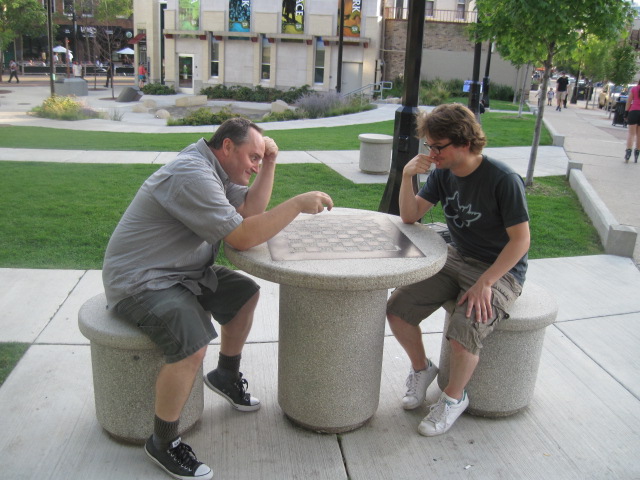
Madison Match-up Madness, culminating in this moment of mental chess between Milwaukee, WI’s The Viper and Ghent, Belgium’s Stijn Debrouwere. Photo by Rob Henn.
PART 4 OF 3 – In the summer of 2009, when The Viper and His Famous Orchestra started playing together again after my return to the Midwest, an innocent self-search on Google turned up the fact that a trad jazz band out of Belgium had posted a cover of “Ich Bin Berlin (The Sundown Song),” a Viper and His Famous Orchestra tune recorded for our Everything for Everyone long-playing CD.
What followed was some frenzied e-mails among the members of the Orchestra, some excited comments to the YouTube video, and a correspondence with the Rambling Boys of Pleasure’s singer/clarinetist/ukulelist, Stijn Debrouwere (including an e-mail interview that you can find here).
Then, one Saturday three years hence, August 18, 2012, we finally got to meet up in person. Stijn travelled to Madison, Wisconsin from Cedar Rapids, Iowa (where he’s been working) and The Viper travelled to Madison, Wisconsin from Milwaukee, Wisconsin (where he hasn’t been working).
After dinner with some friends, we all retired to the Spaight Street home of Orchestra trombonist Rob Henn to make some music: everything from Bob Wills, Roger Miller, and Hank Williams through some Stijn Debrouwere orginals and Viper stand-bys.
Rob documented some of this through his laptop camera/mic and posted the results, with some context, to YouTube, which you can see here.
This is the long awaited international, trans-Atlantic intersection of The Viper and His Famous Orchestra and The Rambling Boys of Pleasure, playing “Ich Bin Berlin (The Sundown Song)” for your orchestrated pleasure.
August 18, 2012 – The Viper (plus Rob Henn) + Stijn Debrouwere
Madison, WI
NOTE: Watching this again in 2019, I’ve decided I really like this recording! I’m not wild about the framing, which was dictated, if I remember right, by the length of Rob’s laptop cord and keeps poor Rob out of the frame and doesn’t show much detail. But I like the sound of the concert and the bartione uke together, I’m impressed that we took the time to compose a new little double-uke intro on the spot, and the performances are pretty lively, kicked up a definite notch or two by Stijn’s presence. Nice work, guys who haven’t yet hit their mid-40s!
NOTE ON NOTE: Watching this again in 2022, I am super happy about everything that happens here! Stijn is great, Rob (even off-screen) makes it happen, and — alluded to in the 2019 note — I LOVE LOVE LOVE the little arrangement at the beginning where Stijn plays the scripted Ink Spots opening and I do a little baritone counterpoint. Just a wonderful memory.
…for being a boss popcorn. Last week, we had an “incident” at the Jerving house in which Jerving-the-youngest accidentally knocked the Toneport USB interface off the desk, bringing a dance-infused session of recording “Starships” with her friend Nala to an abrupt end. John Peacock came to the rescue by letting me borrow his sturdy Tascam US-122: he says “indefinitely” — and now we have that in print — which means that, once again, I can shove all kinds of sounds into my computer.
I tested it out today — doesn’t yet work through the Ubuntu side of my computer, but it does on Windows. The following represents a good five minutes of work, using the Audacity sound editor to lay down three tracks of Fender Telecaster gold, un-amped and plugged in as is directly into the machine.
The sound isn’t actually terrible. The song is an instrumental version of John Papageorge’s Kissyfish classic, “Girlfriend,” from our Grownups Are People, Too tape.
John Papageorge, circa May, 1987, Madison, Wisconsin
the kind of music your great-great-great-grandparents warned your great-great-grandparents about




 The Viper & His Famous Orchestra